David, who is a new hire in Spain, announces that he has finally become a father. But he was reluctant to tell his boss beforehand and didn’t ask for leave. He thinks about whether his leaves will be rejected and if they’re paid or unpaid. His moments of joy suddenly turn into hopeless chaos. Well, it’s not the one story! Thousands of foreign workers face these issues on a daily basis. For all those new fathers, Spain has introduced and amended paternity leave. So that they can have quality time with their newborn! Employers must know how it works to give their workers a moment of relief. These details are briefly discussed in this blog post!
Introduction:
Spain’s 2026 reform expanded employer obligations for paternity leave Spain, increasing compliance complexity for international companies hiring locally.
Being an employer in Spain, you should take care of the paternity leave. These leaves are not optional, negotiable, or informal. It’s a statutory right with strict rules around duration, pay, and administration. The system is generous to employees. But it can feel heavy for foreign companies unfamiliar with Spanish labour law.
No more worries! The blog post shares every little detail you’re looking for.
We explain:
- Paternity leave in Spain
- Your obligations as an employer, and
- Why do many international companies rely on an EOR
What Is Paternity Leave in Spain Today?
Spain’s paternity leave framework reflects the importance of fathers being actively involved from the very beginning of a child’s life. Over recent years, reforms have strengthened fathers’ rights. Now, Spain is among the European countries with the most supportive parental leave policies.
Today, paternity leave in Spain is part of a unified system called birth and childcare leave (permiso por nacimiento y cuidado del menor). Spanish law now gives each parent an individual entitlement to paid leave around the time of a child’s birth, adoption, or foster placement. It means rather than introducing separate maternity and paternity schemes, Spain combines both leaves in a single entitlement. Workers can take this leave to care for and bond with their child. It’s protected by strong employment rights.
The leave covers:
- Birth of a child
- Adoption
- Foster placement
Each parent has their own entitlement. Leave cannot be transferred between parents in two-parent families.
Although people still talk about paternity leave in Spain in everyday language. However, legally, it’s the same statutory framework that applies to both parents. Defined with equal rights and protections. Employers must manage the process carefully. While making sure Social Security and payroll reporting are correct, a task many companies choose to handle through an Employer of Record for compliance and simplicity.
Length of Paternity Leave
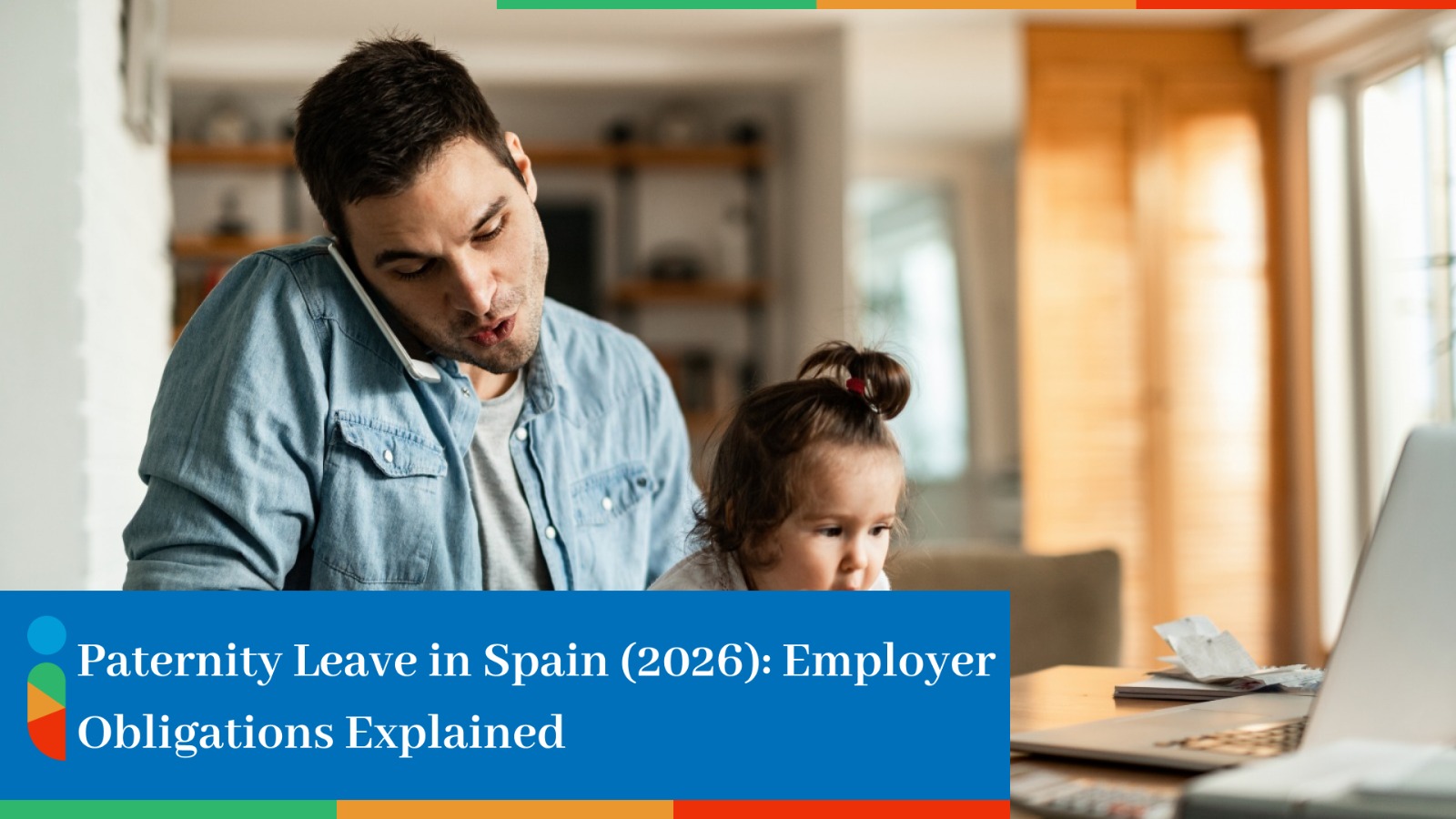
Fathers are entitled to 16 weeks of paid paternity leave in Spain. They’re structured to combine mandatory time at birth with flexible options later on:
Mandatory period (6 weeks after birth)
Fathers must take six consecutive weeks immediately following the birth of their child. This period is compulsory and designed to provide support for the mother and the newborn during the earliest and most sensitive stage.
Optional period (10 additional weeks)
The remaining ten weeks can be taken all at once or split into separate blocks. These weeks must generally be used within 12 months of the child’s birth. It allows families to adapt leave to their personal and professional circumstances.
This structure helps fathers stay closely involved in early childcare while still managing work commitments.
Requesting Paternity Leave and Salary During Leave
In Spain, the process for requesting paternity leave mirrors that of maternity leave. The father must inform the employer and provide documentation confirming the pregnancy. A compulsory thing to do before the birth, along with a formal request outlining the expected leave dates. The birth certificate must be submitted after the child is born and the final leave dates confirmed.
The fathers receive 100 percent of their regular salary during paternity leave. The payment is made through the Spanish Social Security system. It assures income continuity throughout the leave period.
How Long Is Paternity Leave in Spain in 2026?
A major reform that took effect in July 2025 expanded paternity leave. These rules apply throughout 2026.

Length of paternity leave
| Family Type | Total Paid Paternity Leave |
|---|---|
| Two-parent family | 19 weeks per parent |
| Single-parent family | 32 weeks total |
In two-parent households, each parent’s 19 weeks are individual and non-transferable. One parent cannot give unused weeks to the other.
How Paternity Leave Works in Practice
Discover how paternity leave works in Spain.
Compulsory period
The first six weeks of paternity leave are compulsory. They must be taken immediately after birth, adoption, or foster placement. The leaves should be taken full-time and run continuously. This rule is strict, and employers cannot postpone or restructure this period.
Remaining weeks
After the compulsory block, the remaining weeks can be taken in one block or split into several periods. They can be full-time or, by agreement, part-time. By default, these weeks must be used within 12 months of the child’s arrival, unless they fall under the extended flexibility rules below.
New flexibility up to the child’s 8th birthday
The 2025 reform added long-term flexibility:
- Two-parent families
- 3 additional weeks per parent (16 → 19)
- 2 of those weeks can be taken at any point until the child turns 8
- Single-parent families
- 16 additional weeks (16 → 32)
- 4 of those weeks can be deferred until the child turns 8
This means paternity leave requests may appear years after the birth from an employer’s perspective. It makes accurate record-keeping essential.
Employment Protection During Paternity Leave
During paternity leave, the employment contract is suspended, not terminated. The employee keeps their role and core employment rights. Dismissals linked to pregnancy, birth, or the use of paternity leave are generally considered void under Spanish labour law unless the employer can prove a completely unrelated and legitimate cause. This is one of the highest-risk areas for non-compliance.
Managing statutory leave incorrectly can expose your company to penalties or invalid dismissals. Iberia EOR ensures full compliance with Spanish labour law.
How Much Is Paternity Leave Paid in Spain?
Paying your workers on time when they become parents is essential. However, it should be from another source, not from you. But how much should they actually deserve? Below, we have talked about it.
100 percent salary coverage
Paternity leave in Spain is paid at approximately 100 percent of the employee’s regulatory base. Payment comes from Social Security, not directly from you. The employer must still manage payroll coordination, documentation, and reporting. Although paternity leave in Spain is fully funded. Still, employers are required to manage documentation, a process often handled by an Employer of Record.
Eligibility and Application Process
To qualify for paternity leave, the employee must:
- Be legally resident in Spain
- Be registered with the Spanish Social Security
- Meet contribution requirements based on age
Contribution requirements
| Age | Minimum Contributions |
|---|---|
| Under 21 | No minimum required |
| 21–25 | 90 days in the last 7 years or 180 days total |
| 26+ | 180 days in the last 7 years or 360 days total |
The application is submitted to Seguridad Social. But employers must provide accurate employment data and timelines.
Many international companies choose an Employer of Record in Spain to handle leave processing, payroll coordination, and Social Security filings.
Related Rights After Paternity Leave
Paternity leave is part of a wider framework of family rights. Employers should also be aware of:
Breastfeeding leave (permiso de lactancia) → paid time off until the child is 9 months old
Reduced working hours for childcare → with enhanced dismissal protection
Unpaid childcare leave (excedencia por cuidado de hijos)
Managing both parents’ rights? It’s also important to understand how these rules interact with maternity leave in Spain.
Employer Responsibilities: Where Companies Get Stuck
Even though the state pays the benefit, employers must:
- Track compulsory vs flexible weeks
- Coordinate leave timing with Social Security
- Update payroll records correctly
- Protect the employee’s role and rights
- Handle deferred leave requests years later
An Employer of Record in Spain makes sure statutory leave is processed correctly and on time. This reduces the risk of penalties or invalid dismissals. Many international companies rely on an Employer of Record to manage these obligations without opening a local entity.
Why Many Employers Use an EOR for Paternity Leave in Spain
Paternity leave compliance is not only about knowing the rules. But it is also about executing them flawlessly. One missed filing or incorrect timeline can create legal exposure. An EOR manages Social Security filings and assures correct leave tracking. They keep payroll compliant and protect you from labour-law mistakes
Paternity leave compliance isn’t only about knowing the law — it’s about executing it flawlessly.
Hiring in Spain does not have to be complicated. Iberia EOR helps companies employ talent compliantly without opening a local entity.
Let Us Manage Statutory Leave in Spain for You
Iberia EOR never left you alone to face all the burden of staying compliant. But we’re here to help in fixing all the issues that may arise to manage your workers’ leave. The idea of getting assistance will make you more focused on accepting the risks underlying when you fail to meet the law. We don’t want you to see handling government filings. That’s why our EOR services should be your prime choice so that you stay compliant without any fines.
Let Us Manage Statutory Leave in Spain for You.
Common Employer Mistakes with Paternity Leave in Spain
-
Failing to track compulsory vs flexible weeks
-
Incorrect payroll reporting during leave
-
Delaying Social Security filings
-
Mishandling deferred leave requests
-
Terminating employees during protected periods
Frequently Asked Questions
Can an employer refuse paternity leave in Spain?
No. It is a statutory right protected by Spanish labour law.
Do employers pay paternity leave in Spain?
The payment is made by Social Security, but employers must manage payroll coordination.
Is paternity leave mandatory in Spain?
Yes. The first six weeks are compulsory.
Can paternity leave be taken years later?
Yes. Certain weeks can be deferred until the child turns 8 under the 2025 reform.