

Many employers make a huge mistake when hiring workers. They often think that the cost of hiring in Spain 2026 only involves the candidate’s salary. But this is not the case! There are additional costs and benefits that you are obliged to provide to your employees. Wondering what those are? This guide is going to be greatly helpful for you!
Introduction:
The cost of hiring in Spain 2026 goes far beyond agreeing on a salary. Many international employers underestimate how quickly mandatory contributions, compliance requirements, and admin overhead can inflate costs. Eventually, they create legal risk.
Deciding whether to hire directly? Use contractors? Or work with an Employer of Record, this ultimate guide walks you through the real numbers. Read till the end to uncover the hidden expenses and the safest way to hire in Spain in 2026.
Calculate the Cost of Hiring an Employee in Spain
A salary alone does not reflect the true cost of employment in Spain. What matters is total employment cost. Including gross salary plus employer social security, benefits, payroll, and compliance obligations. 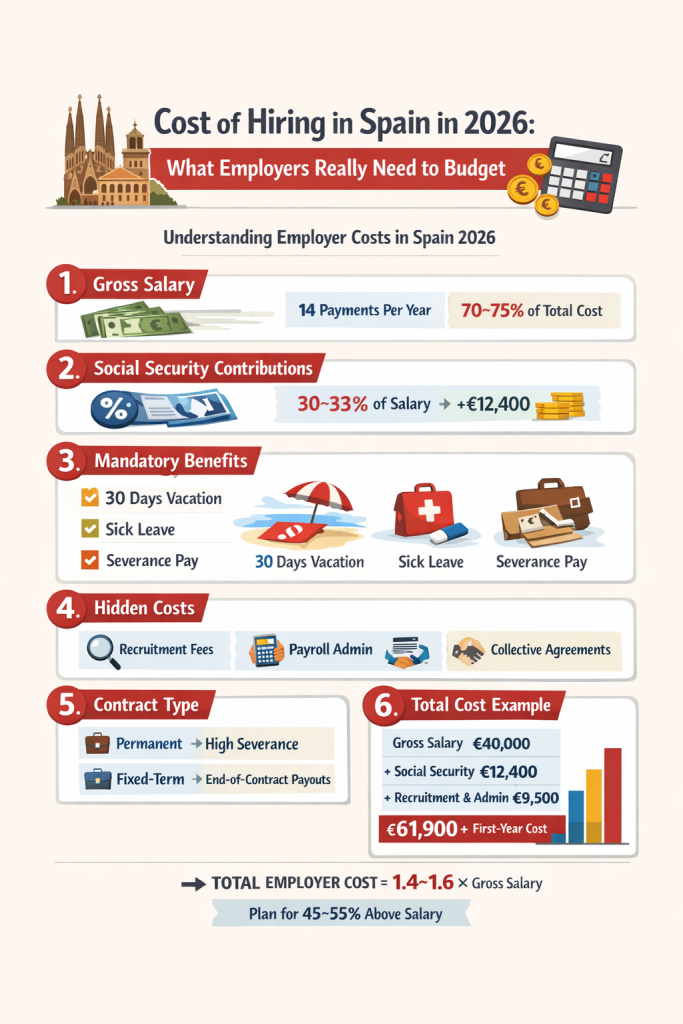
Due to this, many companies run into budget surprises. Employer social security contributions alone add around 30–32 percent on top of gross salary. This increases the cost of hiring in Spain. A great challenge that many companies solve by using an Employer of Record. They manage employment costs transparently and compliantly.
Employment Cost Overview: Spain
Spain offers access to strong EU-based talent with relatively predictable employment costs compared to other Western European markets. That said, costs rise quickly once mandatory contributions and compliance obligations are factored in.
Your total monthly cost per employee generally includes:
- Gross salary
- Employer social security contributions (≈ 30–32%)
- Paid leave and public holidays
- Payroll administration and tax filings
- Legal compliance with labour law & collective agreements
Managing these obligations internally is hard. Especially for companies without a local entity. This can be an expensive and slow move. That’s why many choose an Employer of Record. Eliminates the need to set up a company from scratch.
What’s the Cost to Hire Different Roles in Spain?
The average monthly employment costs are discussed below. We discussed the common roles in Spain in 2026. They combine salaries in Madrid, Barcelona, and Valencia. Along with employer social security contributions.
Worried About Spanish Tax Compliance While Hiring or Relocating Staff?
Average Monthly Cost for 2026
|
Role |
Avg. Gross Salary in € | Contributions by Employer – 30 Percent |
Total Monthly Cost in € |
|
Software Engineer |
3,000 |
930 |
3,930 |
| Product Manager |
3,800 |
1,210 |
5,010 |
| Marketing Specialist |
2,300 |
740 |
3,040 |
| Customer Support Rep |
1,700 |
545 |
2,245 |
| HR Manager |
3,500 |
1,120 | 4,620 |
International companies, senior roles, or highly competitive sectors sit well above these averages.
Note:
These figures are estimates. Don’t consider them as legal minimums. Actual costs vary by seniority, region, collective agreements, and benefits.
Key Budgeting Takeaways for 2026
When hiring in Spain, employers should:
-
Employers pay 30–33% in social security contributions in Spain.
-
Employees receive 14 salary payments per year.
-
Total hiring cost typically equals 1.4–1.6× gross salary.
-
Spain mandates 30 days paid leave + 14 public holidays.
-
Unfair dismissal severance = 33 days per year worked.
Country-Specific Nuances That Impact Spain’s Cost of Hiring:
Hiring in Spain isn’t just about payroll. Several legal and cultural factors directly affect your employment budget.
Leave & Paid Time Off:
Employees are entitled to thirty calendar days of paid annual leave per annum. It equals twenty-two working days. This includes national and regional public holidays. Maternity, paternity, and sickness benefits are also offered in Spain. These are funded through Social Security, which you must plan operationally. Even if not fully paid by the employer.
According to the official Spanish government overview of working hours, paid leave and holidays, employees are entitled to at least 30 calendar days of annual leave.
Mandatory Employer Contributions
Spanish employers must contribute to social security for common contingencies, unemployment insurance, the Wage Guarantee Fund, and vocational training.
These contributions typically add 30–32 percent of gross salary, up to contribution ceilings. Beyond gross salary, these mandatory charges are one of the biggest drivers of the total cost of hiring in Spain — and a common reason companies rely on an Employer of Record to manage payroll and compliance accurately.
Probation and Notice Periods
Probation periods can reach six months for qualified technicians and two months for most other employees, unless collective agreements say otherwise. Notice periods are often 15 days, but dismissals can trigger statutory severance costs, adding financial risk if contracts aren’t handled correctly.
Compensation Structure and Bonuses
Salaries are commonly structured as 12 or 14 payments per year, with summer and Christmas payments treated as a split salary rather than bonuses. Many sectors also apply collectively agreed allowances or variable pay that raise effective employment costs.
Social Security and Tax Compliance
Your company must register with the Spanish Social Security to hire directly. Obtain an employer contribution code. Withhold and remit income tax (IRPF). File payroll and contributions monthly
Mistakes or late filings can result in penalties. Instead of building internal expertise, many employers work with an Employer of Record in Spain to handle these obligations on their behalf.
Employers must pay social security contributions as set by the official social security contribution information for employers in Spain.
Detailed labour regulations are outlined in the Spanish Ministry of Labour official labour guide.
Hidden Costs Employers Often Miss
Being an employer, you might often overlook indirect costs that add up quickly when budgeting for hiring in Spain. You should look for local payroll software and providers. Keep an eye on labour law advice and contract localisation. Consider HR administration and employee support as a hidden expense. There is a chance that you miss out on the cost for ongoing compliance with collective bargaining agreements. Don’t ignore the expense attached to time spent managing audits, updates, and filings.
These hidden costs can rival or exceed employer social security contributions. Especially for companies hiring only one or two employees.
Many businesses choose an Employer of Record rather than absorbing these expenses internally. They help convert unpredictable overhead into a single monthly fee.
Hiring Models Compared – Entity vs Contractor vs Employer of Record
Choosing the right hiring model has a major impact on both cost and risk.
1. Setting Up a Local Entity
Pros
- Full control over employment
- Suitable for large, long-term teams
Cons
- High upfront setup costs
- Ongoing legal, payroll, and HR expenses
- Slow time to hire
- Full compliance risk
Best for companies with significant long-term operations in Spain.
2. Hiring Contractors
Pros
- Appears cheaper upfront
- Faster onboarding
Cons
- High misclassification risk
- Backdated taxes and penalties
- Limited control over workers
Spanish authorities actively enforce employment classification. Initially, what looks cheaper can become very expensive.
3. Employer of Record
Pros
- No local entity required
- Fast onboarding (days, not months)
- Full compliance with Spanish labour law
- Predictable monthly costs
Cons
- Not suitable for every long-term structure
Compared to contractors or entity setup, an Employer of Record offers a faster and legally safer hiring option, especially for companies testing the Spanish market or hiring small teams.
Ready to Hire in Spain Without the Administrative Burden?
How Do You Reduce Hiring Costs in Spain?
Hiring in Spain doesn’t have to mean losing budget control. Make a big difference by implementing some smart strategies.
Plan Around Contribution Caps:
Employer social security contributions are capped. Structuring compensation with these ceilings in mind helps avoid unnecessary costs.
Localise Benefits Strategically:
Workers in Spain often value private healthcare or transport allowances more than cash bonuses. These benefits improve retention without overspending.
Consider an EOR (Employer Of Record):
Running your own entity means payroll systems, tax filings, and compliance administration. An Employer of Record simplifies cost of hiring in Spain under one predictable fee while eliminating legal risk.
Review Contract Types Carefully:
Fixed-term contracts can offer flexibility when you use them correctly. However, you must align with Spanish labour law.
Explore Cross-Border Hiring:
Hiring in Spain through compliant solutions allows access to EU talent without expanding your legal footprint for remote roles.
Should You Hire Directly or Use an Employer of Record in Spain?
Setting up an entity may make sense if you’re hiring at scale and committed long term. An EOR is the safest option if your priorities are speed, cost control, and compliance. Many companies choose an Employer of Record in Spain rather than setting up a local entity. Hiring them reduces upfront costs and avoids legal exposure. Employers get their support to onboard talent quickly.
Final Verdict – The Real Cost of Hiring in Spain
The cost of hiring in Spain is predictable. The key is to account for everything. Employer social security, paid leave, compliance, and hidden admin costs can easily push total employment costs 30 percent or more above salary.
Partner with an Employer of Record if you own a company without an established Spanish presence. They turn complexity into clarity. Their inclusion lets you focus on growing your team, not managing bureaucracy.
Ready to hire in Spain without setting up a company? Contact Iberia EOR today! With us, hire employees in Spain without setting up a company. Our Employer of Record solution best assists you in onboarding talent in days. Have a fully compliant process with clear costs and no surprises.